

What the lender expects, what happens if payments stop, and how it counts in the final settlement.
The rule that surprises people
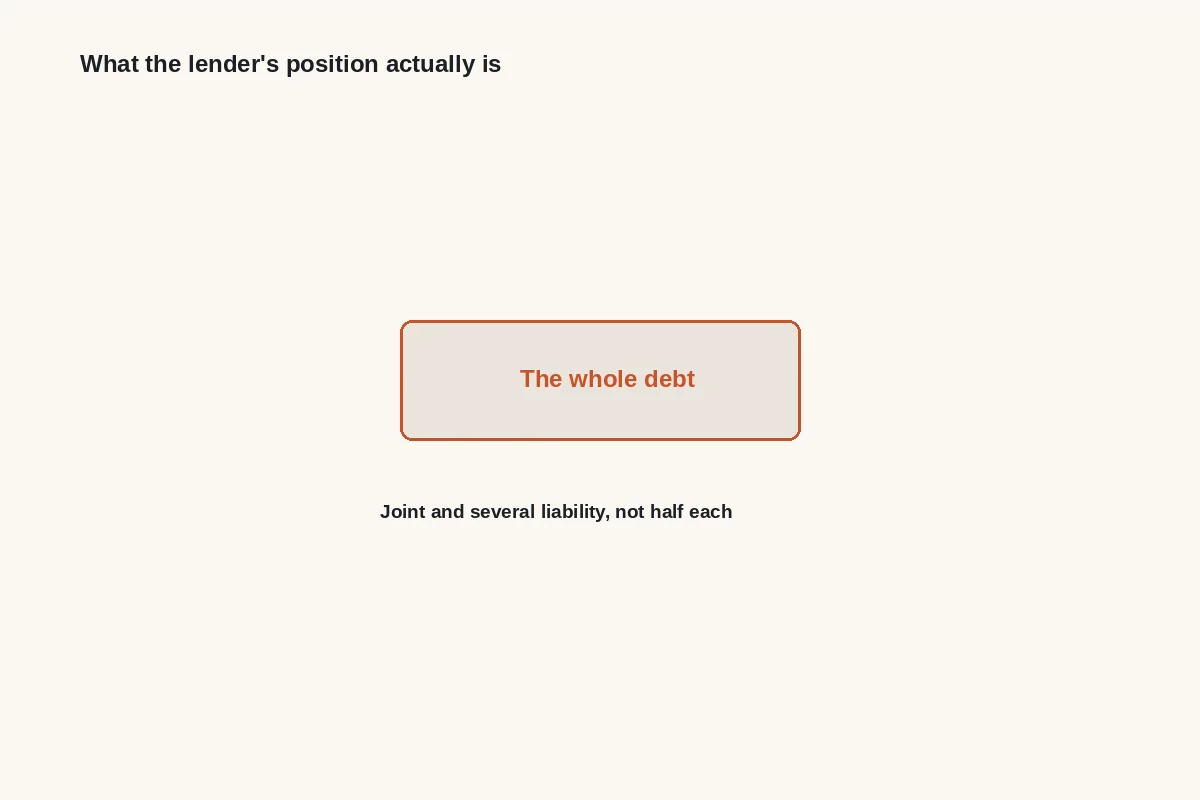
A joint mortgage is joint and several. Each of you is liable for the whole amount, not half of it. If your ex-partner agreed to pay and stops, the lender comes to you for the full payment, and your credit file records the arrears alongside theirs.
Nothing agreed between the two of you changes this. A written agreement, a solicitor's letter, even a court order does not alter the contract with the lender. The order binds you to each other; it does not bind the bank.
Who should pay in the meantime
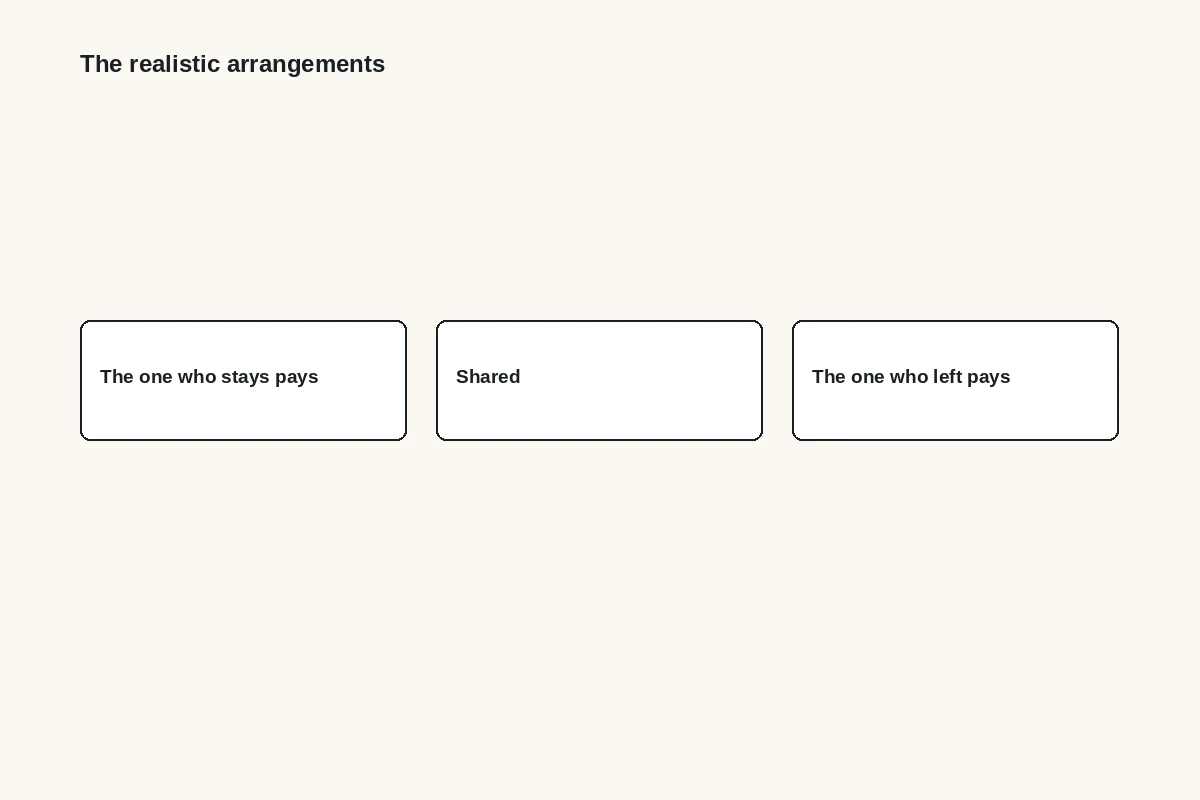
There is no legal default and it depends on circumstances. Common arrangements include the person remaining in the property paying, which reflects occupation. Both continuing to pay their previous share, which reflects the existing pattern. Or the higher earner covering it while the settlement is worked out, which reflects capacity.
What matters most is that whatever you decide is written down, including what happens if it becomes unaffordable, and that it is understood as temporary rather than as setting a precedent.
How payments are treated in the settlement
A party who has paid the mortgage alone since separation will usually argue for credit. Whether they receive it depends on the whole picture: whether they had exclusive occupation, whether the other party was paying rent elsewhere, whether child maintenance was also being paid, and what each party's income actually allowed.
Where one party has exclusive occupation, an occupation rent may be set against the mortgage credit, on the basis that they had the benefit of living there. These offset each other more often than either party expects, and it is a reason not to treat mortgage payments as money that will simply be returned.
The related principle sometimes raised is the equity of exoneration, which can apply where a debt was incurred for one party's sole benefit. It is narrower than people hope and is rarely the answer to a routine mortgage.
If payments cannot be maintained

Speak to the lender early, together if possible. Lenders have processes for exactly this and separation is one of the most common reasons for them. A temporary interest-only arrangement or a short payment concession is far better than arrears, and it is available before default rather than after.
Missing payments while waiting for a settlement damages both parties. Arrears reduce what the property is worth to you, they harm both credit files, and they make it harder for either of you to obtain a mortgage afterwards, which is often the thing the settlement depends on.
Getting one name off the mortgage
Only the lender can release a party, through a transfer of equity, and only if the remaining party can afford the loan alone on the lender's affordability assessment. Agreement between the two of you is necessary and not sufficient.
Where the remaining party cannot qualify alone, the realistic options are sale, or a deferred sale with both names remaining on the mortgage and the terms written down in detail. A deferred arrangement that leaves one party liable for a mortgage on a house they do not live in needs to say what happens if payments stop, and it usually does not.
Practical steps this week
Confirm what the monthly payment is and when it leaves the account. Agree in writing who pays it for the next three months. Check whether your mortgage is on a fixed rate and when that ends, because a rate change during separation reshapes the arithmetic. And speak to a broker about what each of you could borrow alone, because that answer determines which settlements are even available.
What the lender's position actually is
A joint mortgage makes both of you liable for the whole debt, not half of it. That is what joint and several liability means, and it is the single most misunderstood fact in this area.
If one of you stops paying, the lender pursues whoever it can reach. It has no interest in which of you moved out, who the court thinks should pay, or what the two of you agreed. Any agreement between you is enforceable between you and is invisible to the lender.
The consequence follows: a missed payment appears on both credit files. A person who moved out a year ago and assumed they had walked away from the mortgage frequently discovers this when applying for a new mortgage of their own.
Priorities in the first month
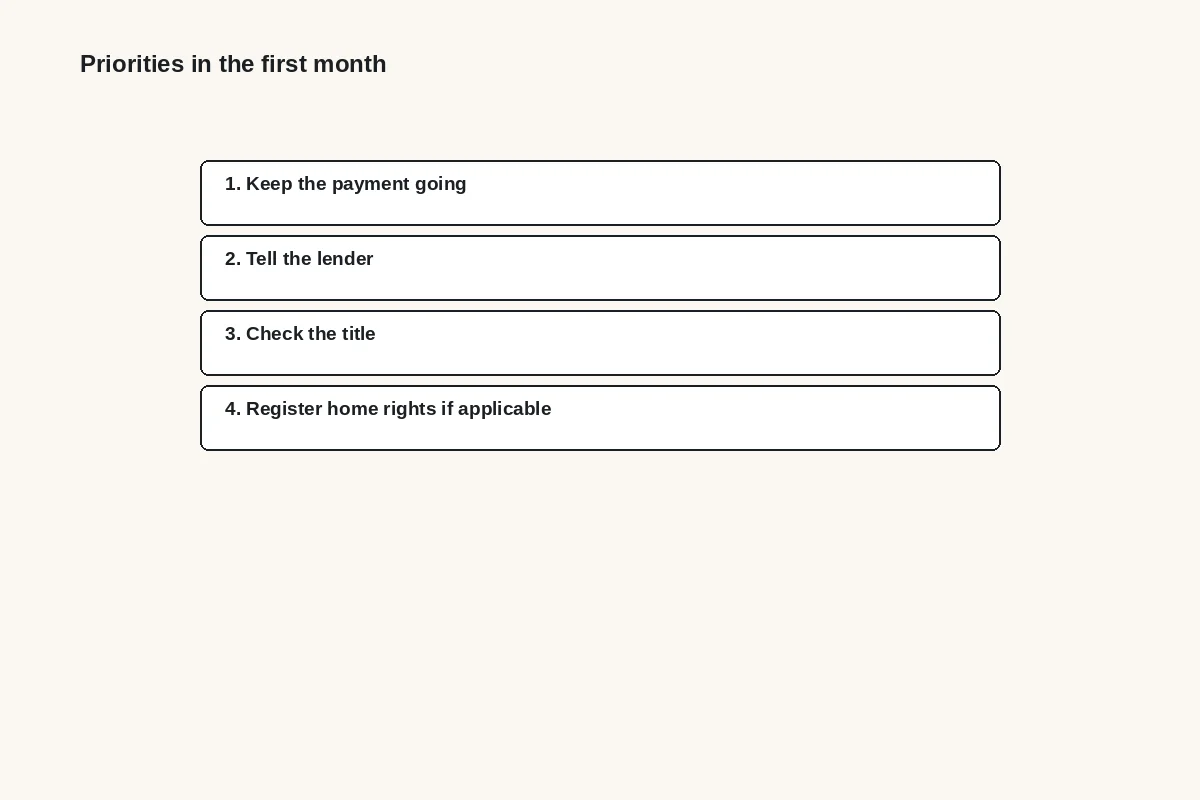
Keep the payment going. Whatever else is unresolved, arrears are the one development that makes every option worse, and they are difficult to undo.
Tell the lender you have separated. Most have a dedicated team, and lenders can offer a temporary interest only arrangement, a payment holiday, or a term extension while things are being worked out. These options exist and they are considerably easier to arrange before a payment is missed than after.
Check who is on the title, which is not always the same as who is on the mortgage. You can obtain the register from HM Land Registry for a few pounds.
If the home is in the other person's sole name and you are married, register a home rights notice against the title. It is a form to HM Land Registry, it costs nothing, and it prevents the property being sold or further charged without you knowing. Home rights arise under the Family Law Act 1996 and they end on divorce unless the court orders otherwise, so this is a step to take early rather than eventually.
The realistic arrangements
The person remaining pays. Common where the remaining party can afford it, and it is usually taken into account in the final division, either as a credit for the payments made or as an adjustment to the equity split.
Payments continue to be shared. Workable in the short term, resented in the long term by the person who has moved out and is also paying rent. It is rarely sustainable past a few months.
The person who moved out pays, either wholly or in part, as a form of spousal maintenance in kind. Sensible where the income difference is substantial, and it needs to be recorded so it is not later characterised as a gift.
Whichever applies, write it down, including how long it lasts and how it is treated in the final settlement. An arrangement nobody recorded becomes an argument nine months later about what was meant.
Whether payments come back to you
Not automatically. The court has a discretion and outcomes vary with the circumstances.
Where one party pays the mortgage while the other lives in the property rent free, the payments are often treated as broadly balancing the occupation, particularly where children live there. Where one party pays the mortgage on an empty property, or is also paying rent elsewhere, an equity credit is more likely.
The word to hold on to is discretion. Anyone who tells you with certainty that you will recover every payment is guessing, and the way to reduce the uncertainty is to agree the treatment in advance rather than argue about it at the end.
Why a transfer of equity is often refused
Only the lender can do this, through a transfer of equity, and it will only do it if the remaining party can carry the whole loan on their own income under current affordability rules.
This is where a large number of separations meet a hard limit. A mortgage that two incomes supported comfortably frequently fails affordability on one, and no agreement between the parties changes that.
Options where it fails: extending the term to reduce the monthly payment, adding a family member as a joint borrower where the lender permits it, one party paying down capital to reduce the loan, or accepting that the property will be sold. Speak to a broker early, because knowing what is possible reshapes the entire negotiation and it is better known in week two than in month six.
Deferring the sale
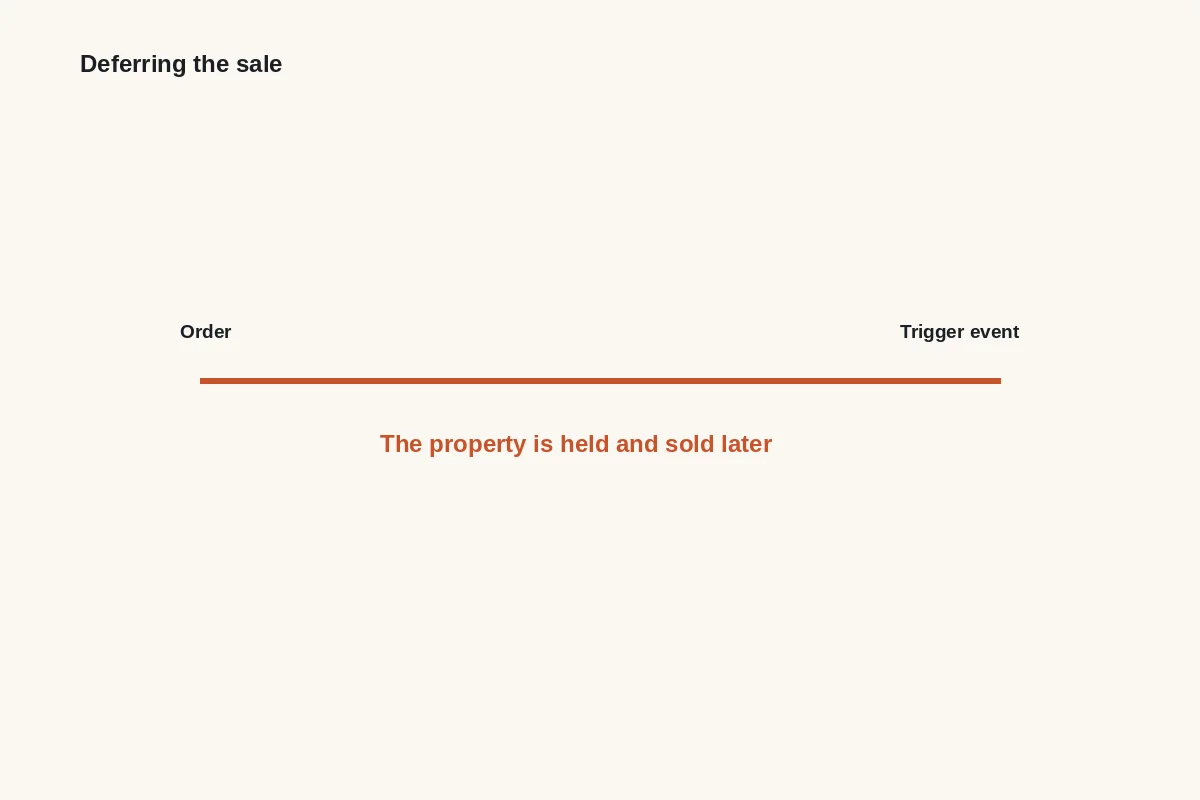
Where the children need to stay and a transfer is not possible, the court can order that the property is held and sold later, on a defined trigger. The youngest child finishing education, the resident party remarrying or cohabiting, a fixed number of years, or a date.
These orders keep a home together and they carry a real cost for the person who stays. They will be maintaining a property they cannot refinance, unable to release equity, and facing a sale at an age when borrowing again may be harder. Where one is used, the detail matters: who pays the mortgage, who pays for repairs, what happens if the payer stops, and exactly how the proceeds divide.
If the mortgage genuinely cannot be paid
Speak to the lender before missing a payment, not after. Speak to a broker about a term extension or a temporary interest only period. Take free debt advice from Citizens Advice, StepChange or National Debtline, none of which charge.
And consider whether selling is the answer sooner rather than later. A sale on your own timetable, out of arrears, produces a materially better outcome for both of you than a sale forced by a lender, and the couples who reach that conclusion early are usually glad they did.
Bringing it into mediation
The mortgage is often the first thing that has to be settled, because it is the payment that falls due next month regardless of what else is unresolved. Mediators deal with it routinely as an interim arrangement, agreed at the first session and recorded, with the final treatment left to the settlement.
Doing it that way takes the immediate pressure off and stops the most urgent problem from distorting every other decision.
How Mediation Direct can help in United Kingdom
Who pays the mortgage now, and what happens to the house in the end. Two different questions.
Frequently Asked Questions About Our Services
My ex moved out. Do they still have to pay?
They remain fully liable to the lender regardless of where they live. What the two of you agree affects the settlement, not the lender's rights.
I have paid alone for a year. Do I get it back?
You will usually argue for credit, and an occupation rent may be set against it if you had exclusive use. They frequently offset more than expected.
Can I stop paying if they will not contribute?
It damages you as much as them. Arrears mark your credit file and reduce what the property is worth to you. Speak to the lender before missing a payment.
How do I get their name off the mortgage?
A transfer of equity, which the lender must approve and which requires you to qualify for the loan alone on their affordability assessment.
Does a court order remove liability to the lender?
No. An order binds the two of you to each other. Only the lender can release someone from the mortgage contract.
What if the house is in one name only?
The named party is liable. The other may still have a beneficial interest or a home rights notice, and should take advice quickly.
Should we sell straight away?
Not necessarily. Sale, buy-out and deferred sale are all viable, and which is realistic usually depends on borrowing capacity rather than preference.
Can we agree a payment holiday?
Lenders have concession processes and separation is a common reason. Ask before missing a payment; the options are much better in advance.
Does paying the mortgage count as child maintenance?
Not automatically. It can be taken into account in an overall agreement, but the Child Maintenance Service formula is separate and does not offset it.
What is an occupation rent?
A notional rent one party may be charged for having exclusive use of the property, commonly set against mortgage payments they made alone.
About the author

Authored and reviewed by Family Mediation Council (FMC) accredited family mediators. Every procedural timeline and statutory requirement is verified against the Family Procedure Rules 2010 Part 3 and current Ministry of Justice standards.
- FMC Accredited
- Standards Board Registered
- Authorised MIAM Provider
- MoJ Voucher Scheme
Talk it through with someone
No obligation, and nothing is decided on the call. We will talk through where you are and what your options actually are.