








What is a Mediation Information and Assessment Meeting (MIAM)?

A Mediation Information and Assessment Meeting (MIAM) is the official statutory starting point for resolving family disputes outside of court. It is an individual 45-minute consultation between you and an accredited Family Mediation Council (FMC) mediator. Your former partner is not present during your MIAM meeting.
Why is a MIAM Mandatory Under UK Law?
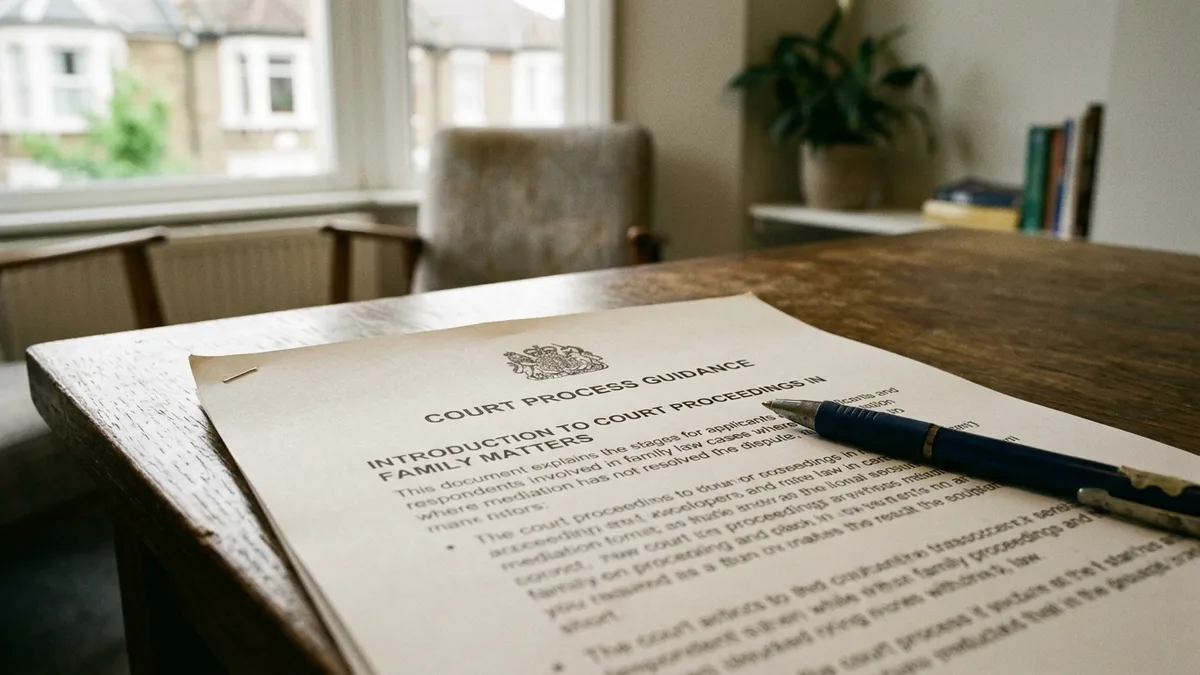
Under Section 10 of the Children and Families Act 2014 and Family Procedure Rules 2010 Part 3, anyone intending to make a court application regarding child arrangements (Form C100) or financial remedy (Form A) must attend a MIAM first. The court mandates this to ensure separating couples are informed of out-of-court options before entering expensive litigation.
What Happens During Your MIAM Consultation

- The mediator explains the family mediation process, timeframes, and fee structures.
- You share your background, key concerns, and preferred outcomes in complete privacy.
- The mediator evaluates case suitability, screening for safety and determining whether direct joint mediation, shuttle mediation, or court proceedings are appropriate.
- We assess your eligibility for the £500 MoJ Family Mediation Voucher Scheme and Legal Aid funding.
- If mediation proceeds, we invite the other party to their individual MIAM. If mediation is unsuitable or declined, your mediator issues your signed court certificate promptly.
Online and Remote MIAM Consultations

We conduct secure, confidential MIAM assessments via video call across the United Kingdom. Online MIAMs allow you to complete your assessment conveniently from home without the need to travel or take extensive time off work.
Who attends, and when

You attend on your own. Your former partner attends their own separate meeting, usually on a different day, and the two conversations do not overlap. Some services offer a joint MIAM where both people are comfortable with it, but individual meetings are the norm and they are always the position where any safeguarding concern exists.
Appointments are available in person and by video. Video has become the ordinary format for most people, and it removes the travel time that used to make arranging a meeting around work difficult. Early and late slots are available with most services, and it is worth asking rather than assuming standard office hours.
What you should bring
Photographic identification and something showing your address. This is a regulatory requirement and every accredited mediator asks for it.
If there is a court deadline, bring the paperwork. If a solicitor has written to you, bring the letter. If you have attended a MIAM before with the same person, mention it, because a meeting within the previous four months can still count for the court form.
You do not need to prepare a case, gather evidence or write anything down in advance. It is an information and assessment meeting, not a hearing, and nothing you say is being tested.
The two halves of the meeting
The first is a confidential safeguarding conversation. The mediator asks about controlling behaviour, about fear, about anything involving the police or social services, and about whether you would feel able to speak freely with the other person present. These questions are asked of everyone, in every MIAM, precisely so that nobody has to raise something difficult unprompted. What you say here is not passed to the other person.
The second is information. How mediation works, what it costs, how long it takes, and what happens at the end. The mediator also explains the alternatives honestly, including solicitor negotiation, the collaborative process, arbitration and court. A meeting that only describes mediation is not an assessment.
What the mediator is deciding
Three things. Whether mediation would be safe. Whether both people are able to take part, which covers capacity, understanding and whether any imbalance between them is one the process can manage. And whether mediation is likely to be useful given what is actually in dispute.
A mediator can conclude that mediation is not suitable, and a reasonable proportion of meetings end that way. That is a legitimate outcome, not a failed meeting, and it produces the signed certificate allowing a court application to proceed.
The certificate, and how long it lasts
Where you go on to apply to court, the mediator signs the relevant section of the application form. For child arrangements that is the C100 and for financial matters the Form A. The signature confirms one of three things: that you attended and mediation is unsuitable, that you attended and the other person declined to take part, or that you attended and mediation is being attempted.
The certificate is valid for four months from the date of the meeting. If you decide to apply later than that, a fresh MIAM is needed.
If the other person will not attend
This is common and it does not stop you. The mediator contacts them, usually in writing and then by phone or email. Where there is no response, or a refusal, that is recorded and your certificate is signed. You attended, which is what the statutory requirement asks of you.
It is worth knowing that a court can take a party's unreasonable refusal to attend into account when deciding who pays the costs of the proceedings. That is set out in the rules, and it is a point many people are unaware of when they decide not to reply.
Funding assessed at the meeting
Two forms of help exist and the mediator will tell you which applies to you.
The Family Mediation Voucher Scheme contributes up to five hundred pounds toward mediation involving arrangements for a child. It is not means tested, it is claimed by the mediator on your behalf rather than applied for by you, and it is one voucher per family.
Legal aid for family mediation still exists, having survived the withdrawal of legal aid from most other family work. It is means tested on income and capital, and where you qualify it can cover the MIAM and the sessions in full. Where one party qualifies, the MIAM is generally free for both, which is a point many people never discover.
Exemptions from the requirement
The requirement does not apply in defined circumstances, including evidenced domestic abuse, child protection involvement, genuine urgency where there is a risk to safety or of assets being dissipated, and several situations where attendance is not realistically possible.
The list is closed and it sits in Part 3 of the Family Procedure Rules. A reason that feels compelling but is not on the list is not an exemption, and courts now check rather than accept a claimed exemption at face value. If you are unsure whether yours applies, a mediator will tell you in a short conversation, which is a better use of twenty minutes than an application returned six weeks later.
What happens next
Nothing automatically. You are under no obligation to continue and many people take the information away and decide over a week or two.
Where you do go ahead, a first joint session usually follows within two to three weeks. For financial matters the mediator will ask you to begin gathering disclosure, and the single most useful thing you can do is request pension valuations immediately, because those take longer than anything else and everything else can be gathered while you wait.


 Face to face sessions
 Online and remote mediation
 Evening and weekend appointments