

Clear, authoritative answers to common questions regarding the family mediation process, costs, and court rules.
Family Mediation FAQs: Family Mediation across United Kingdom.
Everything You Need to Know About Family Mediation
Entering family mediation can feel unfamiliar when you are dealing with the emotional and practical impact of relationship breakdown. Below are detailed, authoritative answers explaining how mediation operates, your legal rights, fee structures, and the statutory requirements under UK family law.
Explore Our Specialised Services
For detailed information on specific mediation areas, explore our dedicated guides for Family Mediation Services, Child Arrangements, Divorce Mediation, Financial Settlements, MIAM Assessments, and the £500 MoJ Voucher Scheme.
Before you start
Most people arrive at family mediation with the same handful of questions, and almost all of them are practical rather than legal. What follows covers the ones asked most often. Where a question turns on your own circumstances, a mediator will answer it directly at the assessment meeting, which is designed for exactly that purpose.
What mediation is, and what it is not

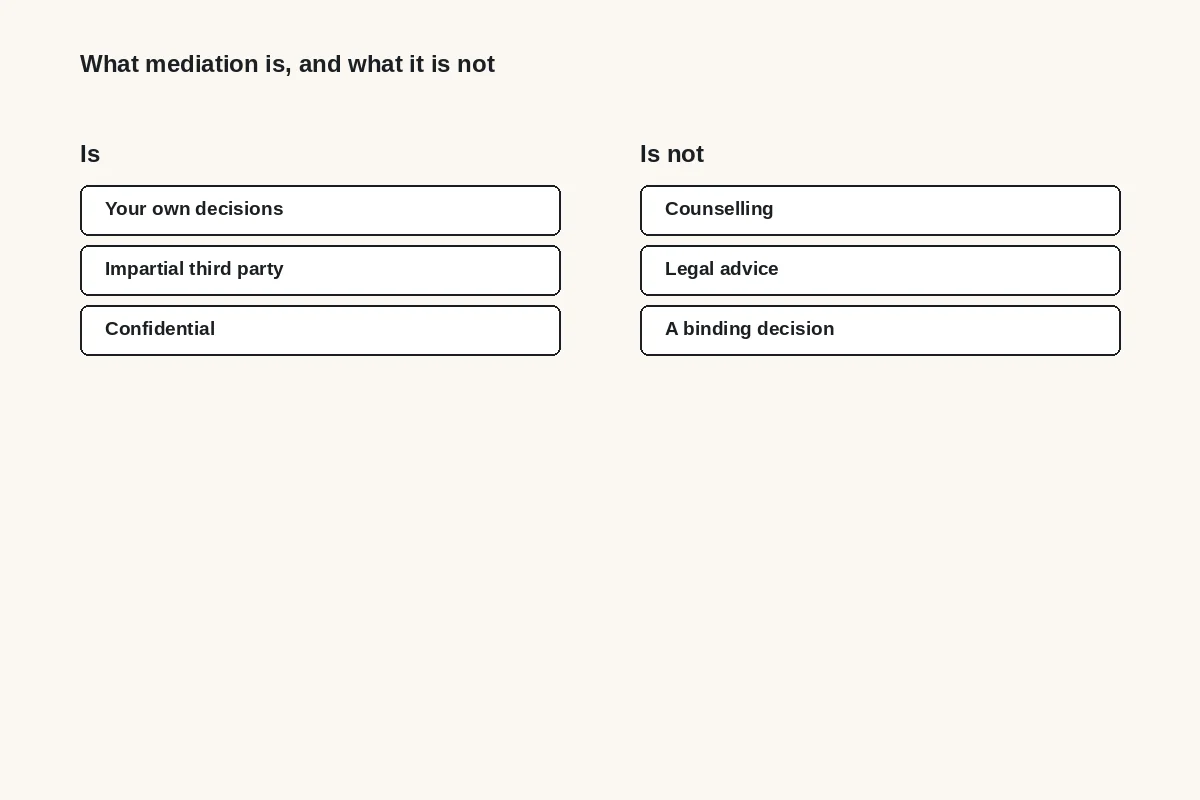
Family mediation is a structured process in which an accredited, impartial mediator helps two people reach their own decisions about children, property, money or all three. The mediator does not decide anything and does not take a side.
It is not counselling and it is not an attempt to repair the relationship. It is not arbitration, where a third party makes a binding decision. And it is not legal advice: a mediator can explain how the law generally applies and cannot tell either of you what you should do.
That last distinction is why independent legal advice sits alongside mediation rather than being replaced by it. Most people take advice at two points, before agreeing anything significant and before signing the final order, and a single appointment costs a fraction of instructing a solicitor to conduct a negotiation.
Whether it is binding

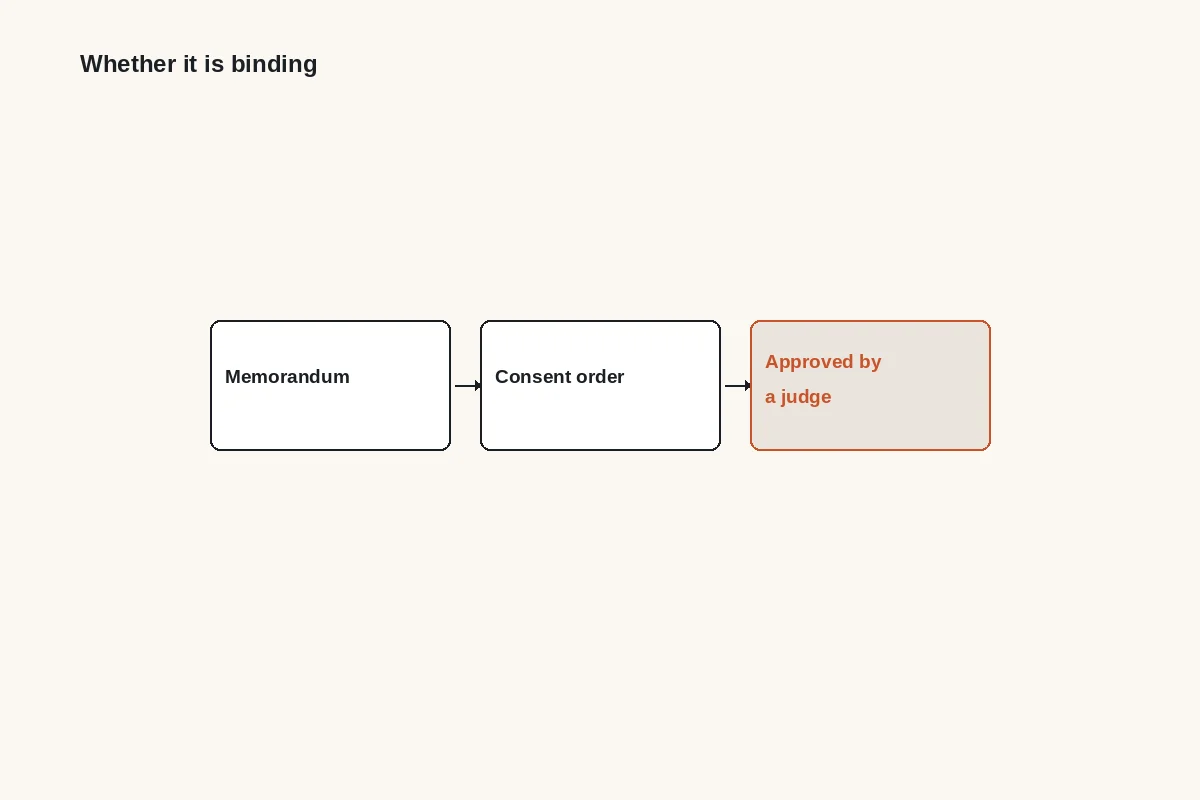
The memorandum of understanding produced at the end of mediation is not itself legally binding. For financial matters it becomes binding when a solicitor converts it into a consent order and a judge approves it, which is the ordinary route and is what makes the outcome enforceable.
For arrangements about children, most families use a parenting plan, which is a written record rather than a court order. It is not directly enforceable, and it carries real weight: a court asked to decide something later will want to know what the parents themselves agreed, and a dated document signed by both answers that in a way recollection does not. Where an order is wanted, the agreement can be put into a consent order too.
Confidentiality
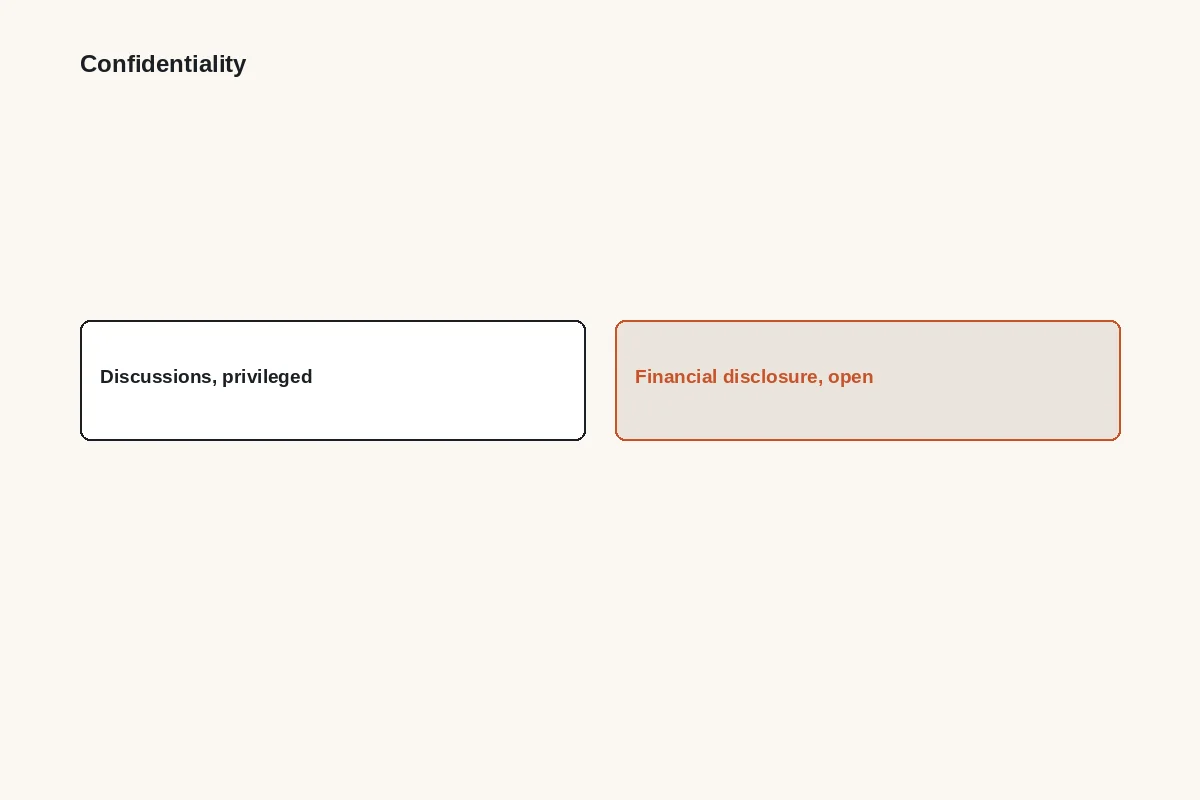
Discussions in mediation are legally privileged and cannot be referred to in court. That protection is what allows people to explore an option without committing to it.
Financial disclosure is the exception and it is deliberately not privileged, so that mediation cannot be used as a place to reveal an asset that then disappears again if the case moves on. The document recording it at the end is the open financial statement, and it is open so that it can be shown to the court with the consent order.
The other exception is safeguarding. Where something indicates a risk of significant harm to a child or an adult, a mediator has a duty that overrides confidentiality, and that is explained before the process begins.
How long it takes
Most cases resolve in three to five joint sessions of around ninety minutes, spread over six to ten weeks. Child arrangements are often faster, financial matters usually slower, and a case involving a defined benefit pension or a business valuation will be governed by how quickly those third parties respond.
The step people forget to budget for comes afterwards. Drafting the memorandum takes a week or two, the consent order two to four weeks, and court approval a further six to twelve weeks. A case that reaches agreement in ten weeks may not have a sealed order for another three months, and knowing that in advance prevents the disappointment of thinking it is finished.
Compare that against the alternative: a contested financial remedy case follows a three hearing structure set by court availability and commonly runs twelve to eighteen months.
If you cannot be in the same room
Shuttle mediation exists for this. Two rooms with staggered arrival times, or two separate video calls, with the mediator moving between them. You do not see each other at any point.
It takes longer and costs somewhat more, because every exchange has to be carried between rooms. It also achieves something proceedings do not, which is that the agreement remains your own. Ask for it at the assessment meeting and you will not be required to justify the preference.
If the other person refuses
You still attend the assessment meeting yourself. The mediator contacts them, records the refusal, and signs your court form. This is the most common misunderstanding about the process: the other person declining is not an exemption from the requirement, and an application made without a signed form on that basis will be returned.
Children's involvement
Children are not part of ordinary mediation sessions. Where it is appropriate, a separately accredited mediator can meet a child individually, usually from around the age of ten, in a short meeting without either parent present.
What comes back to the parents is only what the child agrees can be passed on. The child does not choose the outcome and is told so clearly at the start. The adults still decide; what changes is that they decide knowing something they did not know before.
Cost
A child arrangements case, including both assessment meetings, three joint sessions and the written plan, commonly comes to between nine hundred and fourteen hundred pounds across both people. A financial case with four sessions and the closing documents commonly runs to between sixteen hundred and twenty four hundred, with the consent order a further cost on top.
Where the voucher applies it removes up to five hundred pounds of that. Where legal aid applies it can cover the process in full.
Ask any service four questions before booking: the assessment fee and whether it is per person, the session fee and session length, what is charged for the closing documents, and whether anything else is billed separately. A service that answers those in writing has given you a budget.
When mediation is not the right route
Where you are not safe, where there is a genuine emergency requiring an urgent order, or where you have good reason to believe assets are being concealed and requests have already gone unanswered. In each of those the powers you need are the court's, and exemptions from the assessment requirement exist for exactly this.
Where none of those applies, the assessment meeting is the cheapest information you will buy in the whole process. It commits you to nothing, and it produces the form you need if the answer turns out to be court after all.
Frequently Asked Questions About Our Services
What happens if my former partner refuses to participate in mediation?
Mediation is voluntary. If the other party declines the invitation, your accredited mediator will sign your statutory court certificate (Form C100 or Form A), allowing you to proceed with an application to the family court.
How many joint mediation sessions are usually required?
Child arrangement matters typically require 2 to 3 sessions of 90 minutes. Financial settlements generally take 3 to 4 sessions to review disclosure and formulate settlement proposals.
Is what we agree in mediation legally enforceable immediately?
The Memorandum of Understanding prepared by your mediator is an agreement in principle. It becomes legally binding once a family solicitor converts it into a draft Consent Order and submits it to court for judicial approval.
Can we use mediation if there is a high level of parental conflict?
Yes. In high-conflict situations, we utilise shuttle mediation where both parties sit in separate rooms or separate video rooms, ensuring proposals are exchanged calmly with zero direct confrontation.
How does mediation compare to court proceedings in cost and timeframe?
Mediation typically costs between £1,000 and £1,800 total per couple and concludes within 4 to 8 weeks. Contested court litigation commonly costs over £15,000 per party and takes 6 to 18 months to reach a final hearing.
Do I need to hire a solicitor while undergoing mediation?
While you do not need a solicitor present during mediation sessions, we encourage both parties to obtain independent legal advice to review the final Memorandum of Understanding before formalising it into a Consent Order.
How is financial disclosure verified during mediation?
Both parties provide verified documentary evidence equivalent to court Form E, including 12 months of bank statements, P60s, mortgage redemption statements, and CETV pension valuations.
Can mediated agreements be modified in future years?
Yes. As children grow or financial circumstances change, parents frequently return to mediation for a short review session to update their Parenting Plan smoothly.
Are our children allowed to have input during mediation?
Yes. For children aged 10 and above, an FMC-accredited child-inclusive mediator can conduct an age-appropriate consultation with both parents' written consent.
How do I book an initial MIAM assessment?
You can book your confidential individual MIAM online or by calling our direct helpline. Consultations can be conducted via secure video call or at our regional mediation facilities.
Talk it through with someone
No obligation, and nothing is decided on the call. We will talk through where you are and what your options actually are.